

Referendum and Referenda
2025-2026 General Election U-PASS Referendum Information
Kelowna Regional Transit: Like Your U-PASS. Vote Yes on March 3-6!
U-PASS provides unlimited access to transit at a significant discount – approximately four months for less than the price of one.
What is the referendum question?
Question reads as follows:
Are you in favour of linking the mandatory U-Pass fee to the Kelowna Regional Transit System 30-Day Adult Pass rate, less a minimum 11.25% subsidy from the University of British Columbia, beginning September 2026?
This would result in the U-Pass fee students pay increasing from $63 to $71 per student per term.
Note: In the case of a “no” vote majority, Kelowna Regional Transit may exercise their right under Article 13.3 of the U-PASS agreement to terminate the U-PASS or reduce service levels. Any changes would be effective September 2026.
Yes____ No_____
RESULTS (March 9, 2026)
YES: 1,670
NO: 322
TOTAL: 2,084
ABSTAINED: 92
What does this question mean?
This question asks whether or not you are willing to continue to pay less than one quarter the cost of an adult monthly pass for a semester’s worth of transit. As well, to avoid the requirement of frequent U-PASS referendums in the future, the referendum is looking to link the U-PASS fee to the Kelowna Regional Transit Adult 30-Day fare (less a minimum 11.25% UBC subsidy). This would ensure that U-PASS will remain for years to come, and students will continue to receive the benefits and savings of U-PASS.
If the referendum results in a “no” majority, students risk losing their U-PASS (and having to pay regular transit fares), possible transit service reductions, increased traffic, busier parking lots on campus and potential increases to parking fees.
Who Uses the U-PASS?
During the 2025 academic year at least 6,583 students (representing a minimum of 54% students assessed a U-PASS fee) used U-PASS [1] taking 757,252 transit boardings across the Kelowna Regional Transit System. That’s an average of 18 boardings per student per month, showing that students rely on transit consistently throughout the academic year.
[1] U-PASS users are defined as number of users who used their pass at least once in the semester.
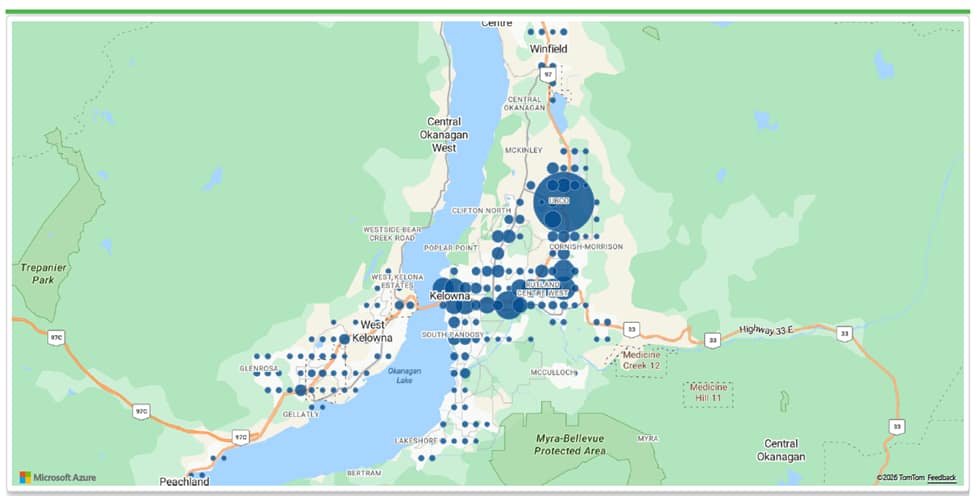
During the summer, 1,175 students opted in, and they used transit even more—26 rides per month on average, compared to 21 rides for all other Umo users without a U-PASS. This suggests many U-PASS summer users rely on transit as their primary way of getting around, even when the program is optional. During the summer, participation in the U‑PASS program is not mandatory, and student enrollment—and therefore the number of U‑PASS users—is significantly lower than during the academic year.
UBCO’s Fall 2025 Transportation Survey found:
- 50% of students listed transit as their primary mode of transportation
- 18% of students listed transit as their secondary mode
- 5% of students who are primary transit users listed no secondary mode—meaning transit is likely their only way to get to campus
U-PASS users also make a significant number of trips from areas with high financial vulnerability. Twenty ‑eight percent of all U-PASS boardings (excluding UBCO stops) originated in neighbourhoods with the highest financial vulnerability index[1], indicating that the U-PASS supports students who may have the fewest transportation alternatives.
[1] The Financial Vulnerability Index uses several household financial indicators to show how financially at risk households are within each neighbourhood. To identify areas with the highest financial vulnerability, neighbourhoods scoring within the top 25% of the Financial Vulnerability Index were selected
How Does the U‑PASS Support Transit for Everyone?
In 2025, U‑PASS revenue totaled $1.56 million, representing 18% of all transit revenue. However, transit service cost $34.78 million, meaning the U-PASS covers only 4% of total system costs.
Since the U-PASS was introduced in 2015, transit service hours—one of the biggest drivers of transit cost—have increased by 17%. These expanded service hours have helped fund the following improvements since the last U-PASS fare increase in 2015:
- Introduction of UMO an electronic fare payment system
- New stations for Route 97 at Sexsmith Rd/Highway 97
- Transit operating centre upgrades to support investments in service
- New and upgraded bus stops region-wide to improve accessibility and add amenities
Since 2016, transit service hours on routes serving UBCO (4, 6, 8, 13, 23, 84, 90, 97, 98) have increased by more than 125 service hours per day during the school year—representing approximately a 50% increase in service to UBCO since 2016.
The most recent service improvements in January 2026 include:
- More frequent service on Route 98 Rutland/UBCO Express (20-minute peak frequency)
- Additional trips on Route 97 Okanagan
- More service hours across the region for improved reliability and frequency
The U-PASS helps ensure that transit remains viable, frequent, and reliable for the entire community.
Why Is Kelowna Regional Transit Proposing a Fee Increase?
Fare increases are necessary to fund transit improvements and better meet student needs. In October 2025, transit fares were increased system- wide for Kelowna Regional Transit. The proposed U-PASS rate increase matches this system-wide increase. Increasing fares from time to time (the last increase was a decade ago) helps to cover some of the increases in operating expenses and allows transit service to keep improving. Without the increase, students risk losing their U-PASS (and having to pay regular transit fares) and possible transit service reductions.

What is a U-PASS?
The Universal Bus Pass (U-PASS) is a mandatory program from September-April for all UBC students who are members of the Students’ Union Okanagan of UBC (SUO of UBC) and have been assessed the SUO fee. The U-PASS entitles holders unlimited access to the Kelowna Regional Transit System at a significant discount – approximately four months for the price of one.
Where did the U-PASS come from?
In September 2007, a Universal Bus Pass (U-PASS) was implemented at University of British Columbia Okanagan Campus (UBC) based on approval through a student referendum.
How much do I save with U-PASS?
A U-PASS for one semester costs approximately 1/4* of the Kelowna Regional Transit rate for an Adult 30-day Pass, which means that UBCO students get four-months for the price of one.
* – On a monthly basis, the U-PASS provides students a significant discount compared to the adult 30-day rate (a $62.25 savings per month).
I’m a Driver—Why Should I Vote “Yes”?
Even if you drive today, the U-PASS still benefits you.
- Parking currently costs $258–$384 per term—4 to 6 times more than the U-PASS.
- Many parking lots are already at full capacity.
- UBCO has no plans to add new parking, and several existing lots are designated for future development.
- As parking supply decreases, parking fees are likely to increase.
If driving becomes too expensive or parking becomes too limited, having a discounted U-PASS ensures you still have an affordable way to get to campus. Voting YES protects that option for you and for future students.
What Happens if Students Vote “No” in the Referendum?
Students risk losing their U-PASS. Without the U-PASS, students would need to pay regular transit fares:
- $80 for a monthly pass
- $6 for a day pass
- $3 for a single ride
Using the current average of 18 rides per month, a student paying single ride fares would spend $54 per month—compared to the $15.75 per month they pay now through the U-PASS.
Without U-PASS, more students may drive to campus resulting in fuller parking lots and the potential for increased parking rates to meet that demand. If students vote YES and keep the U‑PASS, the cost will be $17.75 per month starting September 2026—still far below regular transit fares.
Transit achievements since U-PASS began

Since U-PASS began there have been significant investments made in the Kelowna Regional Transit System including:
‣ New technologies
New technologies have greatly enhanced the bus-riding experience in Kelowna, making riding a bus more convenient than ever. This includes:
- NextRide real-time bus tracking
- Onboard, automated announcements call out stop names
- Electronic fare payment system with the Umo app or Umo card
(with the credit and debit card payment upcoming) - OnDemand service
‣ RapidBus line 97 Okanagan
RapidBus was implemented in 2010 in Kelowna as the 97X. In 2014, the route expanded to the Westside, along with new bus stations added in Kelowna. In 2020, more stations were added at Sexsmith Rd/Hwy 97.
‣ Transit exchange updates over the years
Major exchanges have been constructed and upgraded, including new exchanges in West Kelowna (Westbank/ Elliott, Boucherie), Lake Country (Berry Road), Kelowna (Mission, UBCO Exchange), and significant exchange renewals in Kelowna (Queensway, Pandosy and Okanagan College). More enhancements are being delivered in the next two years at Rutland, Mission and Okanagan College Exchanges.
‣ Operating centre upgrades
Transit operating centre upgrades are underway now to support continuous investments in service in the region and support the transition to low-carbon fleet.
‣ Transit Service to UBCO
UBCO is easily accessed by transit from the UBCO exchange, which connects students to the region with rapid and frequent service routes providing 15–30 minute frequency.

‣ Bus stop infrastructure
New and upgraded bus stops region-wide to improve accessibility and add amenities, such as benches and shelters.
‣ Service Improvements effective January 2026
- Over 18,000 additional hours of service and 6 new buses in the region
- Expanded service on the 98 Rutland/UBCO Express and changes to service on route 8 University/College with 20-minute service during peak times on weekdays
- Restructure of Rutland an Mission area networks
- Additional service on select trips on the 97 Okanagan
- OnDemand new service zone in the Lower Mission neighbourhood
‣ Longer-term investments
Subsequent investment proposals call for over 12,000 additional new service hours, supporting a variety of improvements, including increased weekday and Saturday service on Route 13 Quail Ridge and Route 84 Academy Way.
Where and when to vote
Students will be able to cast their vote, during the Students’ Union Okanagan’s general election between March 3, 2026 and March 6, 2026, via the UBC Simply Voting platform. Students will receive an email prior to the voting period, and a link to cast their individual ballot, using their CWL account.
If you have any questions regarding the U-PASS, please send an email to u-pass@suo.ca, or visit the Students’ Union Okanagan office during regular business hours.